Replanting in our vineyards
Spring — 4 min read
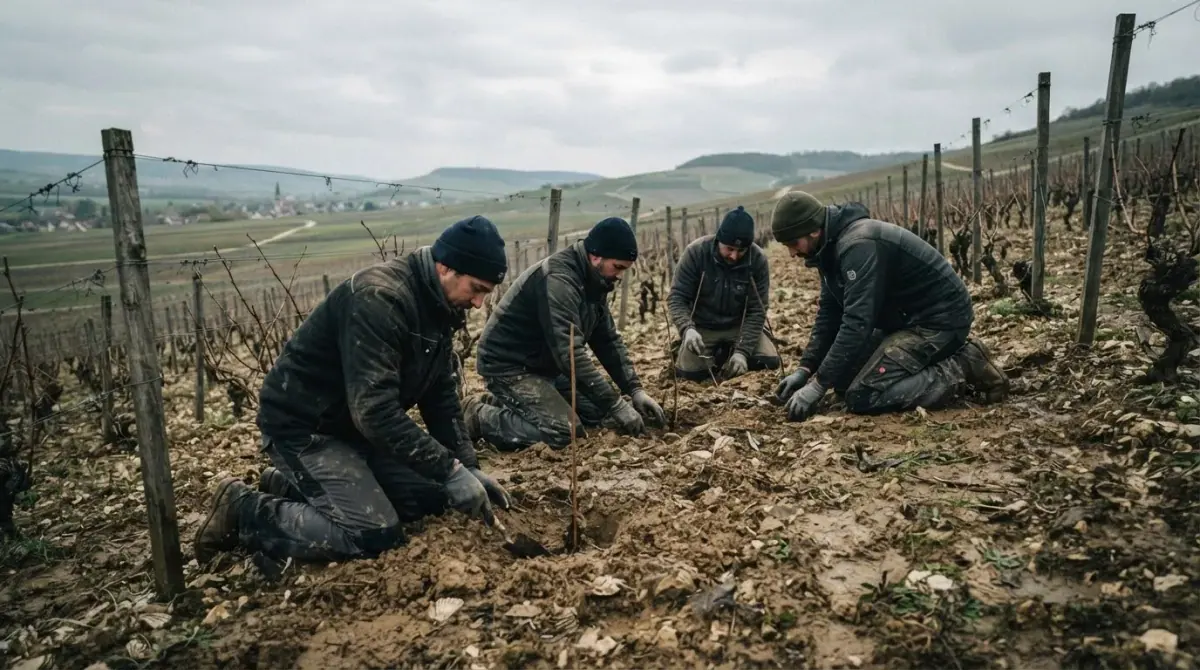
Every spring we go back into the parcels to replace what is missing: we pull up the vines that died over the previous summer, we prepare the holes, and we put young plants into the ground. It is patient work, but it is how the vineyard is rebuilt, vine by vine.
A cycle that starts again every year
Replanting is not an emergency job, isolated within the year. It occupies the whole season: the place is prepared in summer and autumn, the plants go in during spring, and the year after we start again. After the harvest, in October, we walk the rows to mark the dead vines spotted during the summer, then pull them up and prepare the holes that will take the young plants.
The work comes straight after pruning, between the moment the shoots have been cut and the moment we repair the trellis. It is a short window, and it moves with the season: pruning starts between 1 and 11 November and runs until March or April depending on the year. The bending down — laying the shoot along the wire and tying it — is brought forward or held back depending on the frost risk. Replanting, on the other hand, happens in spring.
It is work you cannot see from the road. It does not change the outline of a parcel from one year to the next, and that is precisely why it takes time: it is done vine by vine, hole by hole, and nothing is left out.
Spotting, uprooting, preparing
Three gestures, in that order. First the spotting: during the summer, as we work through the rows for trimming, keeping the rows in order and spraying, we mark the dead vines. The mark is made at the exact place where the vine stood, so that we do not have to look for it in March.
Then the uprooting, in autumn. The dead vine is pulled out of the ground, and the soil is worked back into the old hole. It is hard work: the roots of an old vine resist, and they have to be cleared away completely before the hole can be taken up again.
Then the preparation of the holes. We prepare the soil in advance, so that it is ready to take the young plants in spring. A dead vine is not replaced on the spot: we wait for the end of the season to count what is really missing, once the crop is in and the year is closed.
Done by hand
Replanting is manual work: we dig by hand, set the young plant into the hole, and press the soil down around it. It is a day’s work, repeated as many times as there are gaps in the parcel.
Every hole has to be checked: the plant firmed in, the roots directed downwards, the soil closed properly around them. A badly set plant does not take, and the hole will have to be done again the following year.
It is also the moment to look at the soil. On the slopes of Beine the parcels are worked all year round; the soil we find at replanting is not the soil of the previous spring, and it has to be put back in order before anything is planted.
Repairing the trellis
Right after replanting, we repair the trellis. The wires, the stakes and the ties have taken a winter and a season’s worth of passes: they have to be put back in order before the growth starts again.
The trellis sets the shape the vines will take during the year. It is the lifting of the wires and the tying in of the shoots, from May to July, through the busiest season. A trellis done properly in spring is a parcel that works all year.
Why it matters
A parcel that is never renewed wears out. Replanting keeps the number of living vines steady, and with it the regularity of the harvest from one year to the next. It also preserves the balance of the parcel: a dead vine left in place leaves a gap, and the gap shows at harvest.
Our oldest parcel was planted in 1949 by our grandparents. It has been renewed since, like all the others. Each generation replanted what the previous one could no longer keep alive.
It is this unseen work, repeated every year, that lets the rest of the season run without interruption: pruning, trellising, summer maintenance, harvest, ageing.
Key figures
- Cycle
- Marked in summer · uprooted in October · planted in spring
- Method
- By hand, vine by vine
- Straight after
- Repairing the trellis
- Oldest planting
- 1949, by our grandparents